

Why industrial air purification matters
Most people have changed a furnace filter or run a room air purifier. Those filters clean the air inside a single space. Industrial air purification works on a much larger scale, dealing with the pollutants released by manufacturing, power generation, and other industrial processes.
According to the EPA, about 66 million tons of pollution were emitted into the atmosphere in the United States in 2023. Reducing that pollution depends on two jobs: identifying what is in the air, and preventing pollutants from being released in the first place.
The pollutants being tracked
The EPA sets national air quality standards for six common pollutants, known as criteria pollutants: particulate matter, ground-level ozone, carbon monoxide, lead, nitrogen dioxide, and sulfur dioxide. Most are released directly by combustion and industrial processes. Ozone is the exception. It is not usually emitted directly, but forms when nitrogen oxides and volatile organic compounds react in sunlight.
Identifying pollutants with air monitoring
Air monitoring stations are placed where pollution levels need to be measured. For particulate matter, the work happens on a filter.
- Sample the airA sampler draws ambient air through a filter at a controlled flow rate for a set period.
- Collect particulateParticles in the air are captured on the filter media.
- Weigh and analyzeThe filter is weighed to measure how much particulate was collected, and it can be analyzed further to identify what the particles are made of and where they likely came from.
- Compare to standardsResults are compared against national and local air quality standards.
- Act on the dataWhen levels are too high, the data guides where and how emissions need to be reduced.
Preventing pollutants at the source
On the prevention side, facilities use large-scale control equipment such as fabric filter baghouses, electrostatic precipitators, and scrubbers to capture pollutants before exhaust leaves the stack. When a production process changes, its controls may need to change too, and ongoing monitoring confirms the controls are still working.
Choosing filter media for air sampling
The right media depends on the method and what you plan to analyze. PTFE membranes are called for by the EPA PM2.5 reference method and add little background to samples that will be chemically analyzed. Quartz fiber handles high temperatures and is low in trace metals, which makes it a common choice when samples will be analyzed for carbon. Glass fiber is the filter specified for the TSP high-volume reference method. Always follow the filter requirements in the method and your sampler’s manual.
Products used in this workflow
-

PM2.5 PTFE Filters
Lot-tested against 40 CFR Part 50, Appendix L criteria.
View Product -
PTFE Membrane Filters
Hydrophobic membranes for air and gas filtration.
View Product -
Membrane Filters
The full range of membrane materials and sizes.
Shop Membrane Filters -
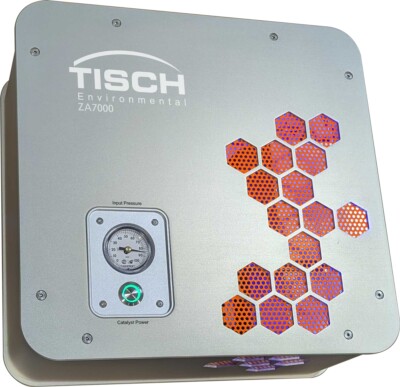
ZA Series Zero Air Generators
On-demand zero air for GC and analyzers.
View Series
Frequently asked questions
How is industrial air purification different from home air filtration?
Home filters, such as furnace filters and room purifiers, clean the air inside a space. Industrial air purification deals with pollutants released by manufacturing and power generation, and it relies on both monitoring to identify pollutants and control equipment to reduce them at the source.
What are the criteria air pollutants?
The EPA sets national air quality standards for six common pollutants: particulate matter, ground-level ozone, carbon monoxide, lead, nitrogen dioxide, and sulfur dioxide.
What filter does the EPA PM2.5 reference method call for?
40 CFR Part 50, Appendix L calls for a 46.2 mm PTFE membrane filter with a 2.0 µm pore size, along with other listed criteria. Tisch Scientific SF18040 filters are lot-tested against those Appendix L parameters.
Why is PTFE used for air sampling?
PTFE is hydrophobic and chemically inert. It lets air pass without wetting out, resists reactive gases, and adds little background to samples that will be analyzed after collection.
Does Tisch Scientific sell air samplers?
Tisch Scientific supplies the filters and consumables used in air monitoring. Our sister company, Tisch Environmental, manufactures air sampling equipment.