

The hidden role of filtration in electronics
When you sit down at your computer, you probably do not think about filters. But the processor inside it was built in a cleanroom, layer by layer, using chemicals, gases, and water that had to be kept almost perfectly clean. Filtration is a big part of how that happens.
The same is true for the electronics in phones, cars, appliances, and wearables. From the chips inside them to the circuit boards that connect everything, clean process fluids help keep defects down and products reliable.
How a chip is made
Semiconductor chips are built on silicon wafers through a cycle of steps that repeats many times.
- DepositThin layers of material are added to the wafer, using processes such as chemical vapor deposition.
- PatternPhotolithography transfers a circuit pattern onto the wafer using light and light-sensitive chemicals.
- EtchMaterial is removed where the pattern calls for it, using liquid chemicals or plasma.
- PlanarizeChemical mechanical planarization (CMP) polishes the surface flat so the next layer can be built on top.
- Clean and rinseThe wafer is cleaned and rinsed with ultrapure water before the cycle starts again.
At every step, the chemicals, gases, and water touching the wafer are filtered to keep particles out.
Why purity matters so much
Chip features are extremely small, so a single particle landing on a wafer can cause a defect in the circuit. Because a chip passes through so many process steps, even a small contamination rate can add up to a meaningful loss in yield.
Water is a good example. The ultrapure water used to rinse wafers is treated to remove nearly all particles, dissolved ions, organics, and microorganisms. Its resistivity approaches 18.2 megohm-centimeters at 25 °C, the theoretical maximum for pure water.
How to choose the right filter
Chemical resistance
Electronics processes use strong acids, bases, and solvents. PTFE has the broadest chemical resistance and is a common choice for these chemicals. Always check your exact chemical against the chemical compatibility chart.
Gas lines
For process gases and vents, use a hydrophobic membrane such as PTFE that lets gas pass while staying dry.
QC and analytical testing
Process chemicals and rinse water are tested in the lab to confirm they meet spec. Filter samples before HPLC with a 0.45 µm syringe filter, or 0.2 µm for UHPLC, and use PTFE for aggressive chemicals.
For bench work, membrane filters and syringe filters fit well, while capsule filters work inline on larger lines. For a specific fab application, talk to our team.
Products used in this workflow
-
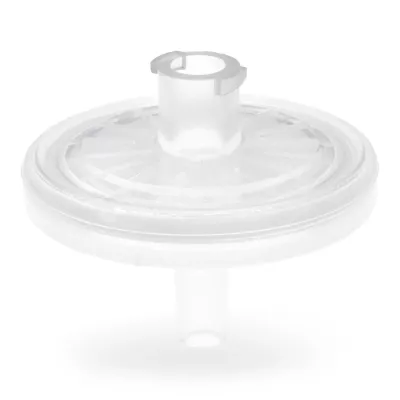
PTFE Syringe Filters, 0.22µm
Sample prep for aggressive chemicals.
View Product -
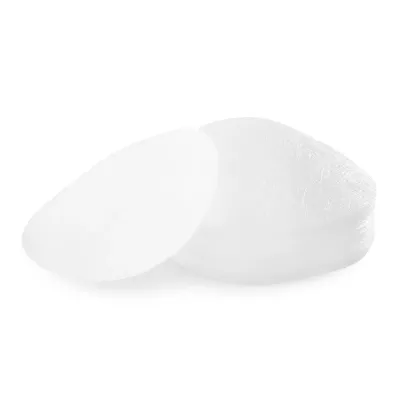
PTFE Membrane Filters, 0.22µm
Chemically resistant lab filtration.
View Product -
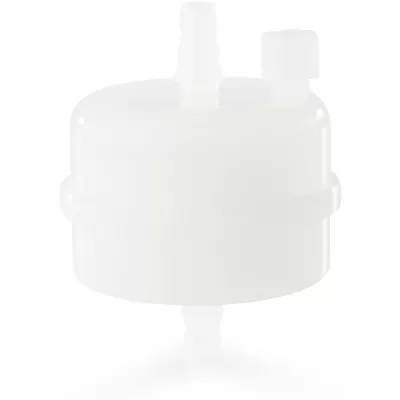
Capsule Filters
Inline filtration for larger lines.
Shop Capsule Filters -
Chromatography Supplies
Vials, caps, and septa for HPLC.
Shop Chromatography
Frequently asked questions
Why does semiconductor manufacturing need such clean chemicals, gases, and water?
Chip features are extremely small, so a single particle landing on a wafer during processing can cause a defect. Because chips are built up through many repeated steps, even a small contamination rate can lower yield.
What are the main steps in making a chip?
Thin layers are deposited onto a wafer, patterned with photolithography, etched to remove material, and polished flat with chemical mechanical planarization. The wafer is cleaned and rinsed between steps, and the cycle repeats many times.
What is ultrapure water?
Ultrapure water is water treated to remove nearly all particles, dissolved ions, organics, and microorganisms. It is used to rinse wafers between process steps, and its resistivity approaches 18.2 megohm-centimeters at 25 °C, the theoretical maximum for pure water.
Which membrane is best for acids and solvents used in electronics?
PTFE has the broadest chemical resistance and handles most aggressive acids and solvents. Always check your exact chemical, concentration, and temperature against the chemical compatibility chart.
Do you supply filters for fab-scale systems?
Tisch Scientific supplies lab and process filters used in electronics work, including PTFE syringe, membrane, and capsule filters. For a specific fab application, talk to our team about your requirements.