

What bioprocessing is
Bioprocessing uses living cells, such as bacteria, yeast, mammalian cells, or algae, to make useful products. Those products include therapeutic proteins, vaccines, industrial enzymes for food and textile manufacturing, antibiotics, biofuels, and biodegradable plastics.
The work is usually split into two stages. Upstream processing grows the cells in a bioreactor or fermenter. Downstream processing recovers and purifies the product. How the product is recovered depends on where it ends up: an intracellular product stays inside the cells, so they have to be broken open, while an extracellular product is released into the surrounding liquid.
Where filtration fits in the workflow
Filtration shows up on both sides of the process. Here is where it typically appears.
- Prepare media and feedsGrowth media and feeds are sterile filtered before they go into the bioreactor. 0.2 / 0.22 µm
- Filter bioreactor gasesAir and gases going into and out of the bioreactor pass through hydrophobic filters to keep contaminants out. 0.2 µm hydrophobic
- Harvest and clarifyCells and debris are separated from the liquid by centrifugation, depth filtration, or microfiltration. For intracellular products, cells are broken open first.
- Concentrate and exchange buffersUltrafiltration concentrates the product and moves it into a new buffer. At the bench this is often done with centrifugal filter tubes. MWCO based
- Purify and final filterChromatography separates the product from remaining impurities, and the purified product is typically sterile filtered as a final step. 0.2 / 0.22 µm
How to choose the right filter
Dead-end or tangential flow
In dead-end filtration, liquid flows straight through the membrane, which works well for sterile filtration and smaller volumes. In tangential flow filtration, liquid sweeps across the membrane surface, which slows clogging and suits concentrating products and exchanging buffers at larger scales.
Hydrophobic for gas, hydrophilic for liquid
Gas and vent lines need a hydrophobic membrane such as PTFE that lets gas through while staying dry. Media, buffers, and product streams need a hydrophilic membrane, ideally a low protein binding one such as PES or PVDF when proteins are involved.
Scaling from bench to process
Most processes start small with syringe filters and membrane filters, then move to capsule filters as volumes grow. Keeping the same membrane material and pore size as you scale helps keep results consistent.
Best practices
- Use a prefilter on heavily loaded streams so your final filter does not clog early.
- Run a small-scale trial before committing a full batch to a new filter or format.
- Check flow rate and pressure ratings when moving to a larger format.
- Check your membrane against the chemical compatibility chart for any solvents or cleaning agents in your process.
Products used in this workflow
-
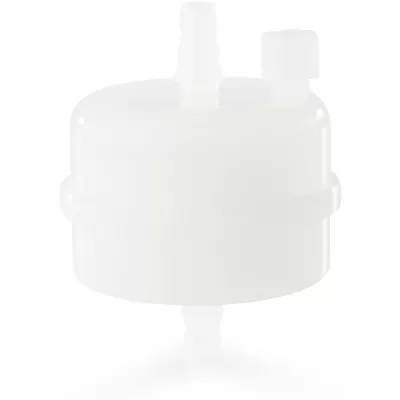
Capsule Filters
Inline filtration for larger volumes and process streams.
Shop Capsule Filters -
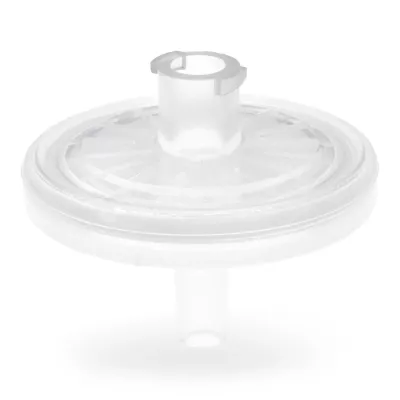
Syringe Filters
Bench-scale sterile filtration and sample clarification.
Shop Syringe Filters -
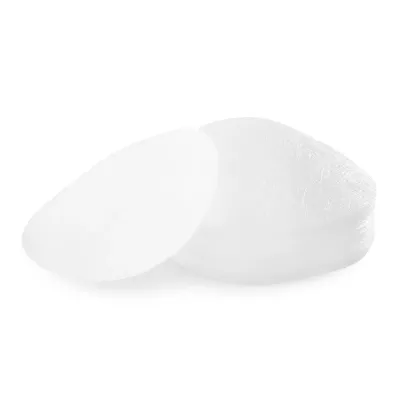
Membrane Filters
Hydrophilic and hydrophobic membranes for liquids and gases.
Shop Membrane Filters -
Centrifugal Filter Tubes
Bench-scale concentration and buffer exchange.
Shop Centrifugal Filters
Frequently asked questions
What is the difference between intracellular and extracellular products?
An intracellular product stays inside the cells, so the cells have to be broken open before it can be recovered. An extracellular product is released into the growth medium, so it can be recovered from the liquid without breaking the cells open.
What is tangential flow filtration (TFF)?
In TFF, also called crossflow filtration, the liquid flows across the surface of the membrane instead of straight through it. That sweeping flow keeps the membrane from clogging as quickly, which makes TFF useful for concentrating products and exchanging buffers at larger scales.
How is air and gas entering a bioreactor filtered?
Gas lines feeding and venting a bioreactor are filtered through a 0.2 µm hydrophobic membrane, such as PTFE. Hydrophobic membranes let gas pass while staying dry, so moisture does not block airflow.
Can I scale up from syringe filters to capsule filters?
Yes. Keeping the same membrane material and pore size as you move from syringe filters to membrane discs to capsule filters helps keep results consistent. Confirm flow rate and pressure ratings for the larger format and run a small trial before a full batch.
What do upstream and downstream mean in bioprocessing?
Upstream covers growing the cells, including preparing media and running the bioreactor. Downstream covers everything after, such as harvesting, clarifying, concentrating, and purifying the product.