Your Cart (0)


← Back to Industrial Filtration
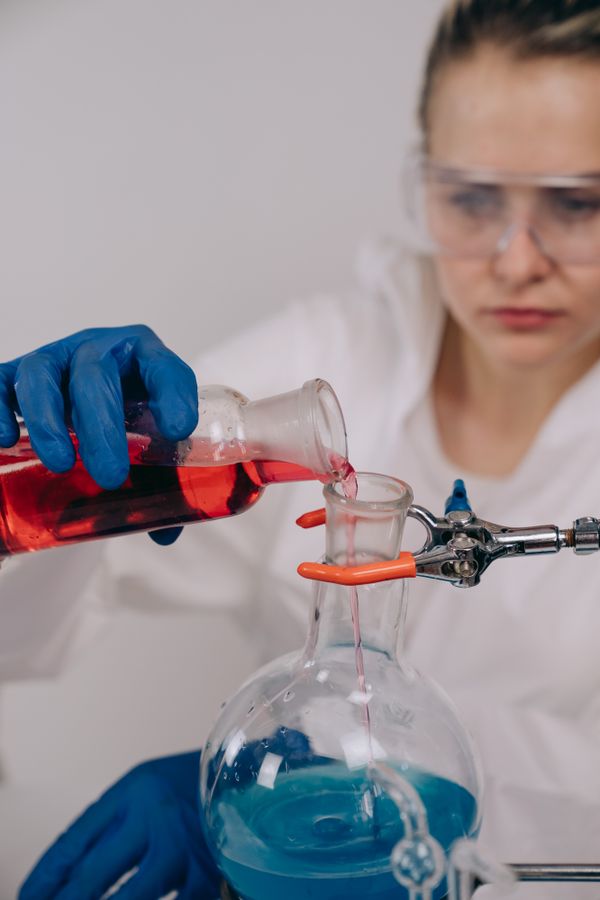
The Essential Role of Filtration Technology in Chemical Engineering
The demands on the chemical engineering industry seem to increase daily. Global manufacturing is always in need of new, sustainable products that have minimal impact on the environment and are cost-effective. Solutions ranging from the development of battery technology for the emerging EV market to the development of new high-strength materials for construction rely on advancements in chemistry.
Filtration technology is indispensable to chemical engineering to help purify raw materials, remove catalysts and impurities, separate solid and liquid phases, clarify liquids, and much more. Moreover, the increased attention on sustainability and eco-friendly solutions places an increased importance on future research and development.
Chemical engineers may work with matter in the four known states — gas, liquid, solid, and plasma. Engineers experiment with the chemical formulas that make up compounds and devise experiments to combine elements, add or remove electrons, or change the state of matter. Each of these processes requires unique techniques for success. For example, changing the state of a solid, like steel, may require extreme heat or a volatile, corrosive acid. Meanwhile, separating nitrogen and oxygen from the atmosphere requires completely different sets of equipment.
Filtration solutions are ideal for a wide range of applications due to their large range of pore sizes and vast array of material types. For example, cellulose filters are ideal for aqueous applications, while polypropylene filters have a high resistance to acids and bases. Nylon filters are well suited for organic solvents that may react poorly with polypropylene. Glass fiber filters have high-temperature resistance, are generally chemically inert, and offer high flow rates.
Filtration technology is generally considered to be a very cost-effective solution for chemists who are looking to maximize their results while minimizing costs. Financial costs, while important, aren't the only cost of chemical development. The cost to the environment, or ecological impact, of many industrial processes, is another key factor impacting the development of chemical solutions. However, pushing these boundaries can unlock amazing new possibilities for chemical processing.
By harnessing advanced materials and techniques, chemical engineers have the potential to not only meet current challenges but also pave the way for groundbreaking discoveries that can transform industries and contribute to a more sustainable future.
PTFE / PP
Top chemically resistant membranes
4 states
Gas · liquid · solid · plasma
Wide pore range
From sub-micron to coarse filtration
Cost-effective
Low-cost purification solution
In chemical engineering, filtration is used at multiple stages of the process — from raw material preparation and reaction clarification through final product purification and analytical quality control. The key variable that determines filter selection is chemical compatibility: the wrong membrane material will degrade or dissolve on contact with aggressive solvents, acids, or bases, compromising both results and safety.
Step-by-step process
1
Raw material prep
Feed chemicals filtered to remove particulates before reaction
2
Reaction / synthesis
Chemical reaction or compound synthesis performed under controlled conditions
3
Catalyst removal
Post-reaction filtration removes catalysts, precipitates, and solids
4
Product clarification
Fine filtration clarifies the product stream for downstream use
5
QC & analysis
HPLC or GC sample prep confirms purity and composition
Key filtration requirements by application
| Application | Filtration role | Best membrane material | Recommended product |
|---|---|---|---|
| Aqueous solution filtration | Particle removal from water-based solutions | Cellulose, MCE, PES | Syringe filters / Membrane filters |
| Acid / base processing | Filtration of corrosive chemical streams | Polypropylene (PP), PTFE | Capsule filters (PP/PTFE) |
| Organic solvent filtration | Clarification of solvent-based reagents | Nylon, PTFE, PVDF | Syringe filters (Nylon/PTFE) |
| High-temperature processes | Particle removal at elevated temperatures | Glass fiber, PTFE | Membrane filters (glass fiber) |
| HPLC / GC sample preparation | Sample clarification before analytical column | PTFE, Nylon (0.2 µm) | Syringe filters / Chromatography vials |
Filter selection tool
Select your chemical process type and scale to get a product recommendation.
Membrane material compatibility for chemical engineering
| Membrane material | Strong acids | Strong bases | Organic solvents | High temperature | Aqueous use |
|---|---|---|---|---|---|
| PTFE | |||||
| Polypropylene (PP) | |||||
| Nylon | |||||
| PVDF | |||||
| Glass fiber | |||||
| Cellulose / MCE |
Recommended
Use with caution
Not suitable
Recommended for chemical engineering
Most used
Syringe Filters
Available in PTFE, Nylon, PP, and PVDF for aqueous, solvent, acid, and base chemical filtration at lab scale.
Shop syringe filters →
Most used
Capsule Filters
PTFE and PP capsule filters for inline filtration of corrosive chemical streams at pilot and production scale.
Shop capsule filters →
Common
Membrane Filters
Glass fiber, PTFE, and PP membrane filters for vacuum filtration and high-temperature chemical applications.
Shop membrane filters →
Common
Cartridge Filters
High-throughput PTFE and PP cartridge filters for large-scale chemical production and catalyst removal.
Shop cartridge filters →
Common
Chromatography Vials
For HPLC and GC analysis of chemical compounds, reaction products, purity testing, and environmental samples.
Shop chromatography vials →
Common
In-Line Disk Filters
Inline PTFE or PP filters for continuous protection of analytical instruments and process equipment.
Shop in-line filters →
Not sure which product fits your process? Use the Filter Selection Guide tab or contact our technical team.
Which membrane material should I use for strong acids and bases?+
PTFE and Polypropylene (PP) are the best choices for strong acids and bases. PTFE is virtually universally chemically resistant and is suitable for nearly all aggressive chemicals including concentrated acids, oxidizing agents, and bases. PP offers good acid and base resistance at a lower cost but has some limitations with certain organic solvents and higher temperatures. Always verify your specific chemical against our Material Compatibility Chart before use.
Why is Nylon recommended for organic solvents but not acids?+
Nylon has excellent compatibility with a wide range of organic solvents — including alcohols, ketones, and esters — making it a good choice where polypropylene might degrade. However, Nylon is not compatible with strong acids or strong bases, which will break down the membrane and potentially contaminate the filtrate. For mixed aqueous/solvent systems or acidic organic solutions, PTFE or PVDF are safer alternatives.
When should I use glass fiber filters in chemical engineering?+
Glass fiber filters are ideal when high flow rates are required, when working at elevated temperatures, or when pre-filtering samples with high particle loads before a finer membrane filter. They are chemically inert to most solvents and acids (though not strong bases) and are commonly used as a depth filter ahead of a 0.2 or 0.45 µm membrane. They do not retain particles as precisely as membrane filters, so they are used for clarification rather than absolute filtration.
How do I choose between PTFE and Nylon for HPLC sample prep in chemical analysis?+
For aqueous HPLC mobile phases and samples, either hydrophilic PVDF or Nylon is preferred — they wet easily and have low background contamination. For organic solvent-based HPLC samples, both PTFE and Nylon work well, but PTFE is more broadly chemically resistant. If your sample contains strong acids or bases, avoid Nylon and use PTFE or PVDF. Always use 0.2 µm for HPLC to protect the column.
Can the same filter be used for multiple chemical streams?+
No. Syringe filters and most membrane filters are single-use disposable items and should never be reused between samples or chemical streams. Reuse risks cross-contamination between samples, membrane degradation, and inaccurate filtration results. For production-scale inline filtration (capsule or cartridge filters), dedicated filter assemblies per chemical stream are also recommended to prevent contamination and ensure consistent performance.
What is the most cost-effective filtration approach for chemical R&D?+
Syringe filters provide the best cost-to-performance ratio for chemical R&D — they are inexpensive, require no additional equipment beyond a syringe, and are available in every membrane material and pore size needed for chemical work. For higher-volume bench work, vacuum filtration with membrane filter discs is also economical. The key is selecting the right membrane material upfront — using an incompatible filter and losing a sample is far more costly than choosing the correct filter from the start.
Tisch Scientific
Find the right filter
for your application
for your application
Browse PTFE, Nylon, PP, PVDF, and glass fiber filters in syringe, capsule, cartridge, and membrane formats — all available in the pore sizes and chemical resistances needed for chemical engineering workflows.