Your Cart (0)


← Back to Bioscience
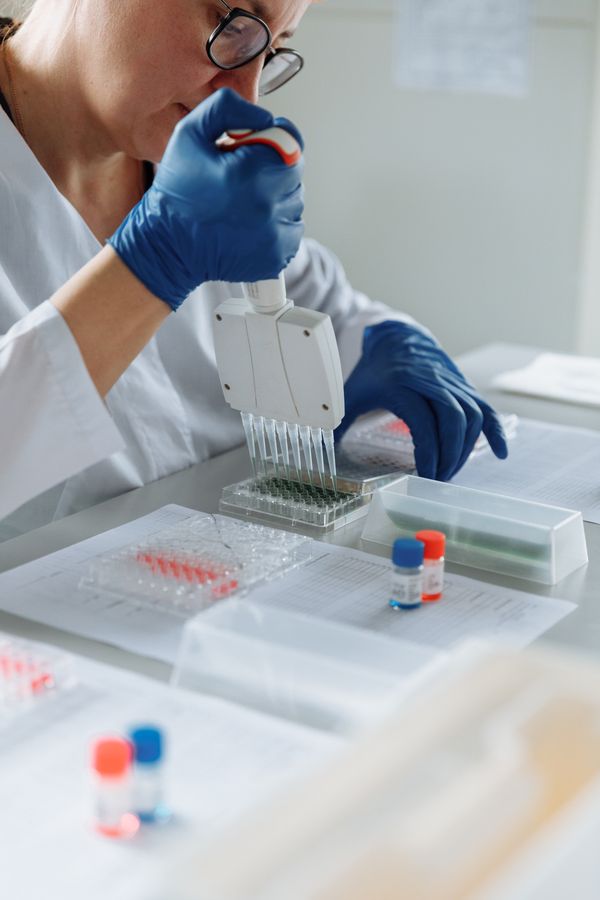
Diagnostic and Clinical Testing
Filtration products serve a critical function in diagnostic and clinical testing. Their primary function is to isolate cells from an analyte for further study or experimentation. While many of these tests originated in a laboratory environment, they are commonly used in homes worldwide.
In a laboratory, scientists conduct an assay to determine the presence, amount, or functional activity in an analyte. For biochemical assays, the intended goal may be to understand the efficacy of a drug or the presence of specific cells or proteins in the analyte.
A lateral flow test begins with placing the analyte on the sample pad at one end of a filtration membrane. Capillary flow occurs as the analyte moves laterally through the membrane. A conjugate pad absorbs the analyte and uses reagents to activate and optimize the target molecule. Once optimized, this molecule seeks out its chemical partner (e.g., an antigen will seek an antibody) and attaches itself, forming a bonded pair. This pair of molecules then collects on a test line and control line. How well the molecules attach to the antibodies in the test and control line determines the test results.
While scientific tests can be very complex, their real-world application is very familiar to many people across the globe. Lateral flow tests are used in home pregnancy tests to detect a specific hormone released during pregnancy. Additionally, many home COVID-19 tests use a similar method to identify the presence of the COVID-19 virus. The filtration medium is the key component that makes each test kit effective.
Specific filtration mediums used in lateral flow testing include nitrocellulose, which displays excellent protein binding properties and provides clear results, making it suitable for various assays. Glass fiber can facilitate faster flow rates when a rapid result is critical, such as in acute testing scenarios, and is also used frequently as a pre-filter to remove large particles from an analyte before sensitive screening processes. Polyethylene membranes are another option, primarily employed for their robustness and compatibility with many reagents, making them versatile for different applications.
As technology advances, innovative filtration mediums will continue to enhance the reliability and accessibility of testing, empowering individuals and healthcare professionals alike to make informed decisions based on accurate results.
Lateral flow
Primary test format
Nitrocellulose
Most common membrane
Lab & home
Wide application range
3 media types
NC / glass fiber / polyethylene
Lateral flow testing is the foundation of many diagnostic products — from home pregnancy tests to COVID-19 rapid tests. The filtration membrane is the core component that drives sample flow, target capture, and result detection. Understanding each stage helps in selecting the right membrane material and pre-filtration approach for your assay.
Lateral flow test — step by step
1
Sample application
Analyte placed on the sample pad at one end of the strip
2
Capillary flow
Analyte migrates laterally through the membrane by capillary action
3
Conjugate pad
Reagents activate and optimize the target molecule
4
Binding
Target bonds with its chemical partner (e.g. antigen–antibody)
5
Result lines
Bonded pairs collect on test and control lines to show the result
Key filtration requirements by process stage
| Process stage | Filtration role | Typical material | Recommended product |
|---|---|---|---|
| Sample pad | Initial sample absorption & flow initiation | Glass fiber | Membrane filters (glass fiber) |
| Pre-filtration (complex samples) | Removes large particles before assay membrane | Glass fiber, 0.45–1.0 µm | Syringe filters |
| Assay membrane | Protein binding, target capture, result lines | Nitrocellulose | Membrane roll stock (NC) |
| HPLC sample prep | Particle removal before analytical column | PVDF or Nylon, 0.2 µm | Syringe filters / Chromatography vials |
Filter selection tool
Select your test type and sample to get a product recommendation.
Lateral flow membrane comparison
| Membrane material | Protein binding | Flow rate | Pre-filter use | Best for |
|---|---|---|---|---|
| Nitrocellulose | Excellent | Moderate | Most lateral flow assays, high sensitivity | |
| Glass fiber | Moderate | Fast | Rapid tests, whole blood pre-filtration | |
| Polyethylene | Low–moderate | Moderate | Reagent-compatible, robust formats | |
| PES / PVDF | Low binding | Moderate | Sample clarification before assay |
Recommended / good
Moderate
Not typical for this use
Recommended for diagnostic & clinical testing
Most used
Membrane Roll Stock
Nitrocellulose and glass fiber roll stock for lateral flow test strip manufacturing and assay development.
Shop roll stock →
Most used
Syringe Filters
0.2–0.45 µm for sample clarification, pre-filtration of complex samples, and HPLC preparation.
Shop syringe filters →
Common
Membrane Filters
Glass fiber disc filters for rapid sample pre-filtration. MCE for general purpose diagnostic workflows.
Shop membrane filters →
Common
Chromatography Vials
For analytical samples requiring HPLC or LC-MS detection. Available in multiple cap and septa options.
Shop chromatography vials →
Common
In-Line Disk Filters
Inline sample filtration for automated diagnostic analyzers and continuous flow testing systems.
Shop in-line filters →
Common
Capsule Filters
Larger volume clarification and sterile filtration for bulk reagent and buffer preparation.
Shop capsule filters →
Not sure which product is right for your workflow? Use the Filter Selection Guide tab or contact our technical team.
What membrane is used in lateral flow tests like COVID-19 or pregnancy tests?+
Nitrocellulose is the most widely used membrane in lateral flow tests. Its excellent protein-binding properties allow antibodies to be immobilized on the test and control lines, enabling reliable and clear results. Glass fiber is commonly used as the sample or conjugate pad component to filter the sample before it reaches the nitrocellulose membrane.
What is a conjugate pad and what role does it play?+
The conjugate pad absorbs the incoming analyte and releases detector reagents — such as labeled antibodies — that bind to the target molecule. It activates and optimizes the interaction between the analyte and the detection system before the sample reaches the test and control lines.
Why is pre-filtration important before running a clinical assay?+
Pre-filtration removes large particulates, cell debris, and interfering substances from complex samples like whole blood or tissue homogenate. This prevents clogging of sensitive assay membranes, reduces background noise, and improves overall assay accuracy and sensitivity.
What filter should I use to prepare samples for HPLC?+
A 0.2 µm syringe filter — typically PVDF or Nylon — is standard for HPLC sample preparation. PVDF is preferred for aqueous samples; PTFE for aggressive organic solvents. Always verify membrane compatibility with your specific mobile phase before use.
Can glass fiber membranes be used for whole blood pre-filtration?+
Yes. Glass fiber membranes are commonly used as pre-filters to separate plasma or serum from whole blood in point-of-care diagnostic formats. Their open structure and fast flow rates allow red blood cells to be retained while the analyte-containing fluid passes through to the assay membrane.
What is the difference between a test line and a control line on a lateral flow strip?+
The test line contains antibodies specific to the target analyte — it only appears if the target molecule is present and has bound to its labeled partner. The control line confirms that the test ran correctly and that fluid flowed through the membrane as intended. A valid result always requires the control line to appear, regardless of the test line outcome.
Tisch Scientific
Find the right filter
for your application
for your application
Browse membrane roll stock, syringe filters, chromatography vials, and more — all available in the materials and formats needed for diagnostic and clinical testing workflows.